Electron
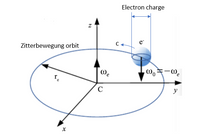
The Italian researcher Giorgio Vassallo proposes a non-standard physical interpretation of Zitterbewegung. It reflects the real internal structure and motion of the electron. The basic idea is that an electron is a massless electric charge moving at the speed of light along a tiny circular orbit (radius ≈ the Compton radius) and that this gives the electron its fundamental properties.
Here is an extension of Vassallo's interpretation:
The electron cannot be a point. If the electron is a circulating charge there is a center point of rotation and a periphery (the electron outer envelope of the electron's trajectories) . If the electron is a rotation is at the speed of light (c) there is a gradient (radial gradient) of the angular momentum and magnetic moment from the periphery towards the center.
The magnetic field potential is the result of the electric field potential and the electric field potential makes the magnetic field potential. The two fields cannot be in phase. So the gradient of the magnetic field result in a gradient of the electric field and vice versa and the two fields are different because of the radial gradient. So the fields under an angular velocity gradient cannot be alike.
In the gradient of rotation, the speed of light becomes strained so that light transfers into mass according to E = mc^2. This is what gives the electron its mass.
Since the magnetic field and the electric field are subject to a gradient, the magnetic field becomes strained and will displace ("twist") the electric field. This is what gives the electron its charge.